
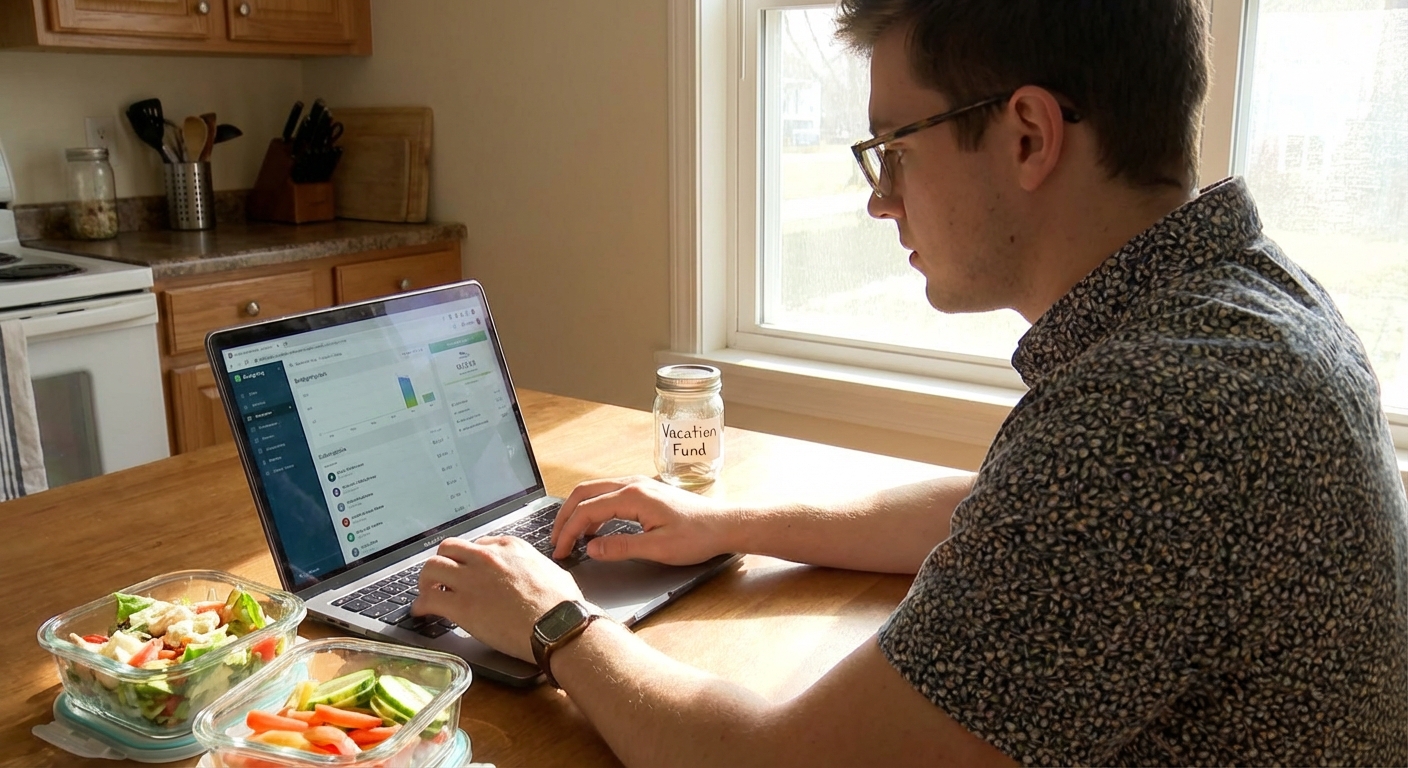
If you’ve ever thought, “I make okay money… so where is it all going?” — you’re not alone.
Why Your Wallet Feels Empty (Even When You Earn Decently)
Behavioral economists call it “money leakage”: the small, forgettable spends that never feel like a big deal, but quietly wreck your bank balance.
A 2023 survey found the average person underestimates their monthly “little expenses” by 37%. That’s hundreds — sometimes thousands — of dollars you don’t even remember spending.
The good news? You don’t need a second job or a finance degree. You need 7 minutes a day and a few tiny money habits that do the heavy lifting for you.
“We don’t get rich by being perfect. We get rich by being consistent.”
— Ramit Sethi, author of I Will Teach You To Be Rich
Let’s rebuild your money life in micro moves.
1. The 60-Second “Wake-Up” Check
Time: 1 minute
Savings: Stops you from overdrafting and paying dumb fees
Every morning, before social media, open one money app:
- Your main bank app, or
- Your budgeting app, or
- Your credit card app
Just look at the numbers. No spreadsheet. No guilt. No decisions.
Why it works:
- People who check their accounts weekly are over 2x less likely to overdraft.
- Seeing your balance creates a “financial speed bump” before impulse spending.
Action step: Move your bank app to your home screen. First tap of the day: money, not memes.
2. The Subscription “Body Count” Method
Time: 7 minutes (one-time, then quarterly)
Potential savings: $600–$1,200/year
Most people think they have 4–5 subscriptions. Research shows many actually have 10–13.
Do this:
- Open your bank and credit card statements for the last 90 days.
Hit Ctrl+F (or search) for these words:
- “SUBSCRIPTION” - “PREMIUM” - “MEMBERSHIP” - Apple / Google / PayPal 3. Make a list. Next to each one, write: - Use weekly? (Yes/No) - Life is worse without it? (Yes/No)
If it’s not a double yes, cancel it.
Money psychologist Dr. Brad Klontz notes, “We get more joy from using one great service often than from paying for ten we barely touch.”
Pro tip: Don’t click “cancel” inside an app. Go straight to your bank or card and hit “stop recurring payment”. Cancel first, reconsider later.
3. The 24-Hour Cart Rule (The Anti-Regret Hack)
Time: 0 minutes (it’s a rule, not a task)
Savings: $50–$300/month in impulse buys
Here’s the deal:
- If it’s under $25, buy it.
- If it’s $25–$250, add to cart and wait 24 hours.
- If it’s over $250, wait 72 hours and research alternatives.
Why it works:
- 88% of online shoppers admit to impulse buys they later regret.
- Most cart items are forgotten in 24–48 hours.
If you still want it in 24 hours? Great. That’s a conscious purchase, not a dopamine swipe.
Bonus hack: When you return to your cart, remove one item, even if you buy the rest.
4. The 1% Richer Rule
Time: 2 minutes (once)
Wealth boost: Tens of thousands over time
Instead of trying to “budget perfectly,” focus on getting 1% richer every month:
- Log into your paycheck or bank deposit settings.
Automatically move +1% more of your income into:
- A savings account, or - A retirement account, or - An investment account
If you save 5% now, make it 6%. Next quarter, 7%. You’ll barely feel it.
Vanguard data shows people who automatically increase savings are up to 3x more likely to hit long-term goals.
Action step (today): Increase your savings or investments by just 1%. Calendar a reminder to bump it another 1% in 90 days.
5. Implement the “No Two Splurges” Rule
Time: 0 minutes (ongoing guideline)
Savings: Keeps lifestyle creep in check
You’re not a robot. You should spend on fun.
But here’s the hack: you can splurge, just not twice in a row.
- Fancy dinner? Next meal = simple, cheap.
- Uber to work? Next trip = bus, bike, or walk.
- Bought new sneakers? Skip clothes shopping next weekend.
This slows down lifestyle creep — the silent assassin of every raise and bonus.
Quick script: Before buying, ask: “Did I already treat myself yesterday?” If yes, delay.
6. Convert Prices to “Work Hours,” Not Dollars
Time: 1 minute (mental muscle)
Effect: Smashes impulse spending
Take your after-tax hourly rate. If you earn $20/hour after taxes and fees:
- $80 dinner = 4 hours of work
- $250 headphones = 12.5 hours of work
People who convert prices to work hours report spending less and regretting less.
Action step:
Estimate your after-tax hourly rate:
- Take-home pay per month ÷ (4.3 weeks × 40 hours)
Before buying anything over $50, ask: “Is this really worth X hours of my life?”
7. Turn “Found Money” into Future Money
Time: 3 minutes per windfall
Wealth boost: Magnifies raises, refunds, and bonuses
Most people treat extra money like play money.
Your new rule: Split all surprise money 50/40/10:
- 50% → savings or investments
- 40% → debt, if you have it (or more savings)
- 10% → guilt-free fun
Found money examples:
- Tax refund
- Work bonus
- Side gig income
- Cash gifts
“Your raises and windfalls are your fastest path to wealth — if you don’t instantly spend them.”
— Tiffany Aliche, The Budgetnista
Action step: Decide now where your next windfall will go. Pre-decisions beat in-the-moment willpower.
Your 7-Minute Daily Money Routine (Copy This)
Here’s a simple routine you can literally screenshot and follow:
- Morning (1 minute): Open bank app, glance at balance.
- During the day: Follow 24-hour cart rule and “no two splurges.”
Evening (2–3 minutes):
- Check one account (debt, savings, or investing). - Ask: “Did I spend in line with my goals today?” No judgment, just awareness.
Once a week (7–10 minutes):
- Scan for subscriptions and small leaks. - Move any leftover cash to savings.
You don’t need a perfect budget. You need a system that fits into your actual life.
Actionable Takeaways You Can Do Today
- Increase your automated savings or investments by 1%.
- Cancel at least one subscription you don’t truly use.
- Install the 24-hour cart rule on every purchase over $25.
- Decide your “found money” rule before your next windfall hits.
Tiny money moves, done daily, quietly become $5,000+ a year in wins.
You’re not bad with money — you’ve just been playing without a system. Now you’ve got one.