
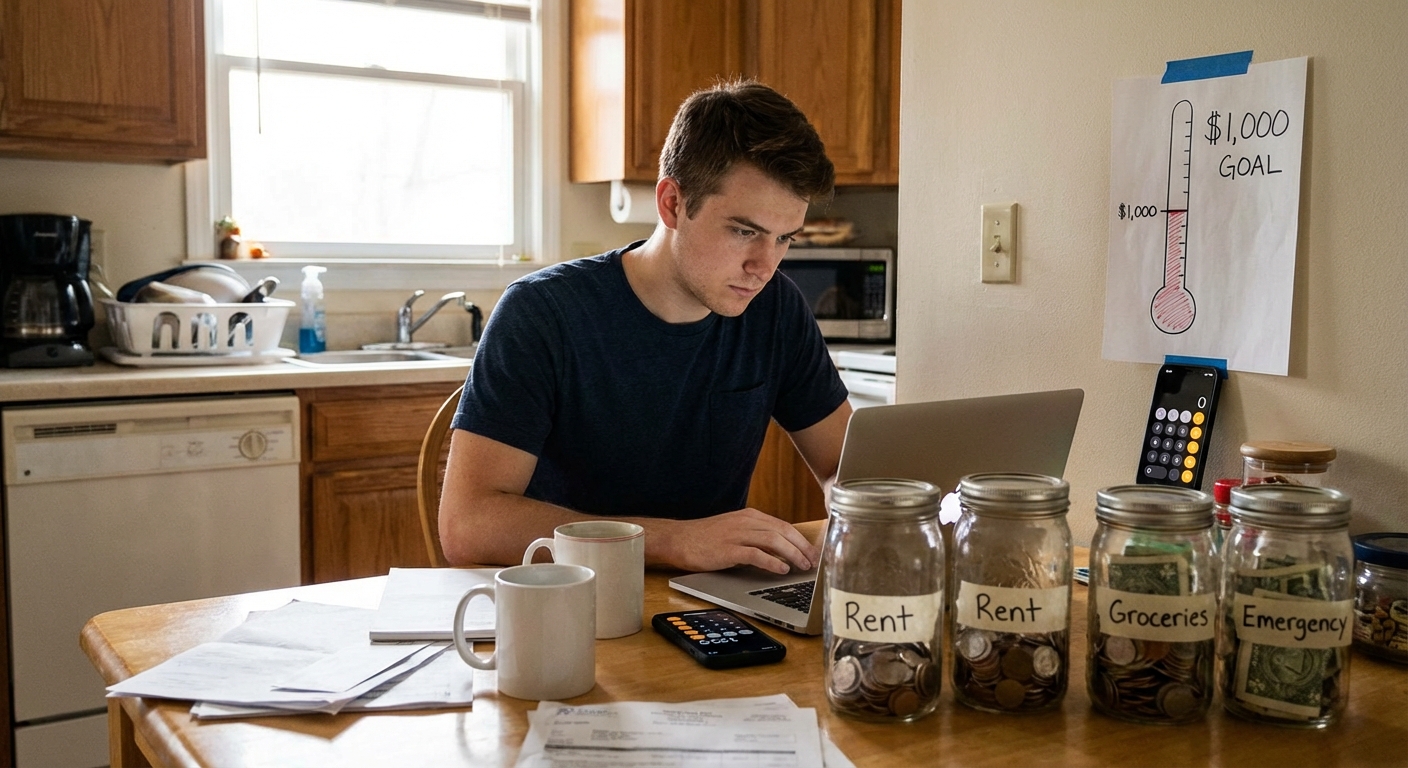
An extra $1,000 in your account doesn’t sound life‑changing — until your car dies, your dog gets sick, or your phone crashes into the toilet.
Why $1,000 Changes Everything
According to the Federal Reserve, 37% of Americans can’t cover a $400 emergency without borrowing. That’s not a math problem; it’s a stress problem.
A small emergency fund is a shock absorber. It doesn’t make you rich, but it keeps you from going deeper into debt every time life sneezes.
“The first $1,000 is less about interest rates and more about breathing room.”
— Erin Lowry, author of Broke Millennial
Here’s a fast, practical playbook to get to $1,000 — even if you currently feel broke.
Step 1: Rename Your Account (Yes, Really)
Ever notice how you treat a “Vacation Fund” differently than “Savings”? Words matter.
- Open your banking app.
- Create a new savings account (most banks let you do this in minutes).
- Name it: “Emergency Freedom Fund” or “Crisis-Proof Cash”.
Corny? Maybe. Effective? Extremely.
People with named goals save up to 31% more, according to a study in the Journal of Marketing Research.
Action: Set it up today, even if you put $5 in to start. Momentum beats amount.
Step 2: Do the 24‑Hour Cash Audit
You don’t need a full budget spreadsheet. You need a snapshot.
For the next 24 hours:
- Write down every single purchase — coffee, snacks, rides, subscriptions.
- Use your notes app or a piece of paper.
At the end of the day, sort them into:
- Musts: Rent, basic food, transport to work
- Nice-to-haves: Takeout, streaming, extra drinks, random Amazon stuff
“Most people can’t cut ‘rent’ or ‘electricity’ easily. But they can absolutely cut ‘scroll shopping.’”
— Dr. Sarah Newcomb, behavioral economist
Circle three nice-to-haves you’re willing to shrink or pause for 30 days.
Step 3: Run the 30‑Day Money Sprint
Your Emergency Freedom Fund is a sprint, not a forever diet.
For 30 days:
- Pause or shrink the three circled spends.
- Every time you don’t buy something you normally would, immediately transfer that money to your fund.
Examples:
- Skipped $7 latte? Move $7.
- Canceled $15 subscription? Move $15.
- Cooked at home instead of $25 takeout? Move $25.
This creates a powerful brain link: “Small choices now = bigger safety later.”
Goal: Aim for $5–$15/day into your fund. That’s $150–$450 in month one.
Step 4: Sell the “Lazy Assets” in Your Space
Everyone has $100–$500 of forgotten stuff lying around.
Look for:
- Devices: old phones, tablets, headphones
- Fashion: shoes, jackets, bags in good condition
- Fitness: dumbbells, yoga mats, machines you don’t use
- Hobbies: cameras, instruments, craft gear
Platforms:
- Facebook Marketplace
- OfferUp
- Poshmark / Depop
- eBay
Pro reseller tip from side‑hustle coach Chris Guillebeau: “Take bright photos in daylight, list slightly under market, and accept the first good offer. Speed over perfection.”
Rule: Every dollar from selling stuff goes straight to your Emergency Freedom Fund.
Realistic target: $150–$600 in 2–3 weeks.
Step 5: Add a One‑Month Micro Side Hustle
You don’t need a forever gig. You need a one‑month cash boost.
Pick something you can start this week:
- Service: Pet sitting, dog walking, babysitting, house cleaning
- Skills: Simple Canva designs, editing documents, tutoring, social media help
- Delivery: Food delivery or ride share on weekends
If you make $80 extra per week for one month, that’s $320. Make $150/week? That’s $600.
Non‑negotiable rule: Side‑hustle money goes 100% to the fund, not lifestyle upgrades.
Step 6: Use the “Round Up & Lock” Hack
Many banking and fintech apps let you round up every purchase to the nearest dollar and move the change to savings.
Example:
- Spend $7.40 → $0.60 goes to savings
- Spend $13.10 → $0.90 goes to savings
Average users stash $20–$50/month without noticing.
Turn this on. Then, in your app settings:
- Hide this account from your main dashboard, or
- Turn off instant transfer back to checking, if possible
Out of sight = less temptation.
Step 7: Automate $10 You’ll Never Miss
Automation beats willpower.
Set a recurring transfer of $10–$20 per week into your Emergency Freedom Fund.
If that sounds tiny, remember:
- $10/week = $520/year
- $20/week = $1,040/year
Add that to your sprint, side hustle, and selling stuff, and $1,000 appears much faster than you think.
“We overestimate what we can do with discipline and underestimate what we can do with automation.”
— James Clear, author of Atomic Habits
How This Can Realistically Add Up
Let’s say you:
- Cut expenses: $150 in 30 days
- Sell unused stuff: $250
- Side hustle one month: $320
- Round-ups + auto-saves: $60
You’re at $780 in a month or two — with most of the hard work already done. Another paycheck or two of $50–$100 clipped from spending, and you’ve hit $1,000.
No lottery. No miracle. Just short‑term focus.
What to Do Once You Hit $1,000
You did it. Now:
Protect it:
- Keep it in a separate high‑yield savings account. - Do not invest it — emergency funds should not be in the stock market.
Define “emergency”:
- Yes: car repair, medical bill, job loss, emergency travel - No: concert tickets, vacations, holiday shopping 3. Refill rule: If you use it, pause extra fun spending until you rebuild it.
Then, and only then, move on to bigger goals like debt payoff and investing.
TL;DR: Quick Action Checklist
- [ ] Open & name a dedicated Emergency Freedom Fund
- [ ] Do a 24‑hour spending audit and pick 3 things to cut for 30 days
- [ ] List at least 5 items to sell this week
- [ ] Start a one‑month micro side hustle
- [ ] Turn on round‑up savings
- [ ] Automate $10–$20/week into the fund
Your first $1,000 won’t make you rich. But it will make you safer, calmer, and more in control.
That’s the foundation every other money win is built on.