
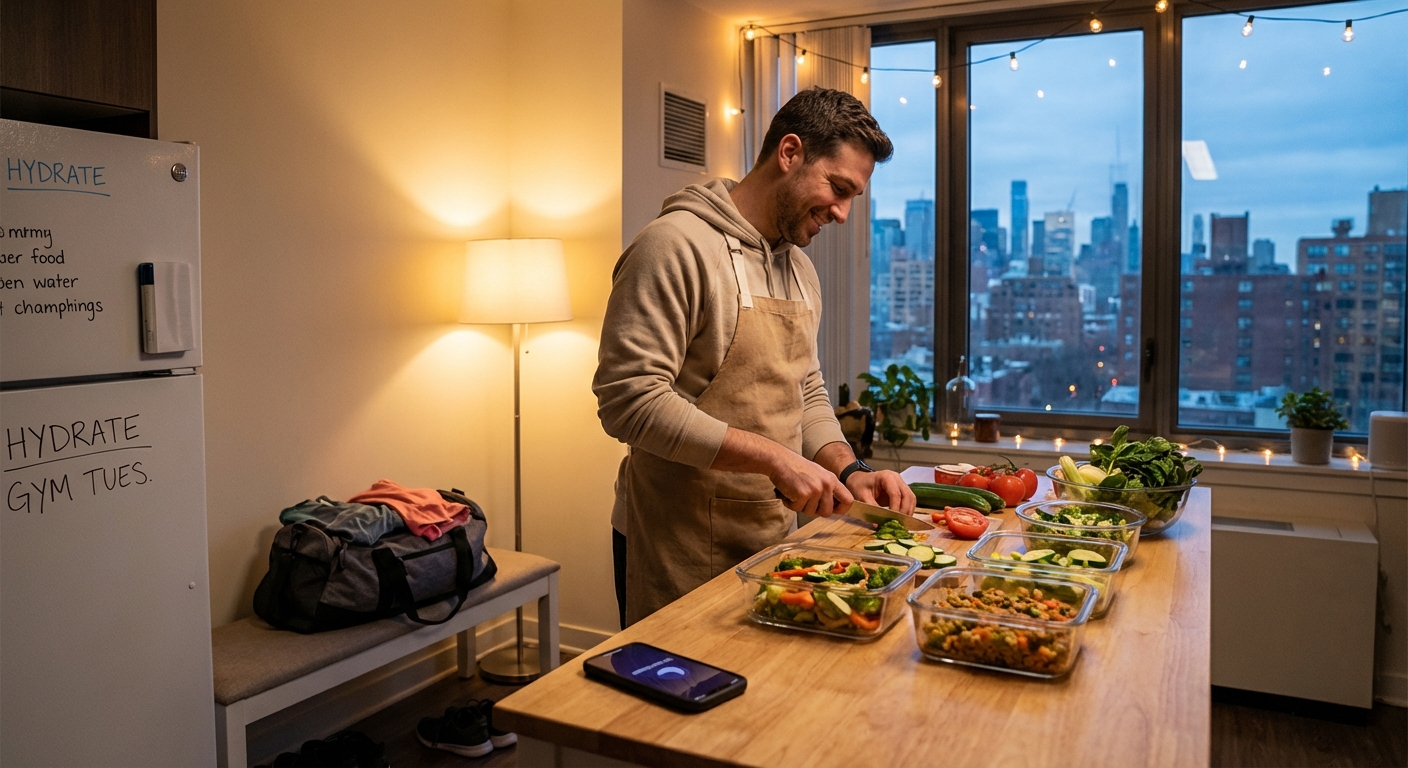
Motivation is loud, unreliable, and never there when you actually need it.
Motivation Is a Terrible Boss
If your self‑improvement plan depends on “feeling motivated,” it’s already dying.
The people who look effortlessly disciplined? They’re not powered by endless willpower. They’ve built “low‑willpower lives” — systems that make good decisions the default, not the battle.
Neuroscientist Dr. Tali Sharot puts it bluntly:
“We are predictably irrational. If you want different outcomes, don’t change your mind. Change your environment.”
Let’s build a life that improves itself, even on your worst days.
Step 1: Identify Your High‑Risk Zones
Your day has danger zones where willpower reliably collapses:
- Late nights
- After work
- When you’re stressed or scrolling
Instead of promising you’ll be “stronger next time,” assume you won’t be.
Action move (5 minutes):
- Grab a piece of paper.
Write: “When I’m tired, stressed, or bored, I usually…”
3. List three common behaviors (e.g., binge‑watch, doomscroll, junk‑snack, online shop). 4. Circle the one that hurts you most over time.
That’s your High‑Risk Zone #1.
Step 2: Replace, Don’t Resist
Self‑control feels like holding a beach ball underwater. It always pops back up.
Instead of resisting a bad habit, pre‑install an alternative.
Behavior guru Nir Eyal explains:
“You can’t call something a distraction unless you know what it’s distracting you from.”
So don’t just say “I’ll scroll less.” Say:
- “When I reach for my phone at night, I’ll open my Kindle app instead of Instagram.”
- “When I want to stress‑eat, I’ll drink a glass of water and wait five minutes.”
Action move (3 minutes):
Fill in this template for your High‑Risk Zone:
“When I usually [unhelpful behavior], I will [neutral or positive alternative] first.”
You don’t have to ban the old habit forever. You just delay it and give your brain another option.
Step 3: Make Bad Habits Annoying (and Good Ones Easy)
You’re lazy. So is everyone else. Use it.
Harvard researcher Shawn Achor found that adding just 20 seconds of friction can dramatically reduce a behavior.
He hid his TV remote in another room. Watching Netflix got annoying. Reading got easier.
Use the Friction Flip:
- To do less of something → add friction.
- To do more of something → remove friction.
Examples:
Add friction (for bad habits):
- Remove food apps from your phone; keep them only on your laptop.
- Log out of social media so you must type your password every time.
- Keep junk food in the hardest‑to‑reach cabinet (or just don’t buy it).
Remove friction (for good habits):
- Sleep in workout clothes.
- Keep a book in your bag, car, and bathroom.
- Put a water bottle on your desk every night before bed.
Action move (5 minutes):
- Add one step between you and your worst habit.
- Remove one step between you and your best intended habit.
You’re not becoming “stronger.” You’re just becoming strategically lazy.
Step 4: Automate What Your Future Self Always Forgets
If it can be automated, it should be.
Why?
Because your future self:
- Will be tired.
- Will forget.
- Will rationalize terrible decisions.
Automation makes self‑improvement happen even when you’re not thinking about it.
Money automation ideas:
- Auto‑transfer a small, fixed amount to savings every payday.
- Auto‑pay your credit card in full to avoid late fees.
- Auto‑invest a tiny percentage into a retirement account.
Health automation ideas:
- Schedule recurring grocery deliveries with a “healthy basics” list.
- Pre‑book recurring workout classes or walks with a friend.
Action move (10 minutes):
Pick one automation this week:
- Set a recurring calendar reminder: “Plan this week’s meals” every Sunday.
- Or set up an auto‑transfer: even $10 a week is momentum.
“The single best strategy for behavior change is making the good thing the easy thing.” — Prof. Katy Milkman, Wharton
Step 5: Use the 3‑Question Daily Reset
You don’t need a perfect morning routine. You need a fast reset when the day goes sideways.
Here’s a 60‑second check‑in you can use at lunch, after work, or before bed.
Ask yourself:
What drained me today?
What gave me energy today?
What’s one tiny tweak I can make tomorrow?
No journaling marathon. Just three bullet points.
Over a month, you’ll start to see patterns:
- People who always drain you
- Tasks that always energize you
- Environments where you always win (or lose)
Action move (2 minutes tonight):
Answer those three questions in your notes app. That’s it.
Surprising Fact: Your Willpower Is a Shared Battery
Research from Florida State University suggests that willpower acts like a shared energy resource.
The more decisions you make — especially emotional, stressful ones — the more your self‑control tanks.
That’s why you:
- Make decent food choices at 10 a.m.
- And demolish a family‑size bag of chips at 10 p.m.
The solution isn’t “be tougher at night.” It’s protect your battery:
- Simplify outfits or meals.
- Use checklists instead of relying on memory.
- Batch annoying tasks into one block.
Use your limited willpower to build systems, not to firefight.
The Low‑Willpower Life, in One Glance
You’re building a life where:
- Bad habits are slightly annoying to do.
- Good habits are ridiculously easy to start.
- Key behaviors are automated.
- You assume your future self will be tired, distracted, and weak — and you design for that.
“Design beats discipline. Every. Single. Time.” — behavioral designer Julie Dirksen
Shareable Takeaway: Don’t Upgrade Yourself. Upgrade Your Defaults.
You don’t need to become a new person to improve your life.
You need to:
- Find your High‑Risk Zones.
- Replace, don’t resist.
- Flip friction.
- Automate the important.
- Run a 60‑second daily reset.
Self‑improvement isn’t about waking up motivated.
It’s about waking up in a world that quietly nudges you toward the person you want to be — even when you’d rather hit snooze on everything.