
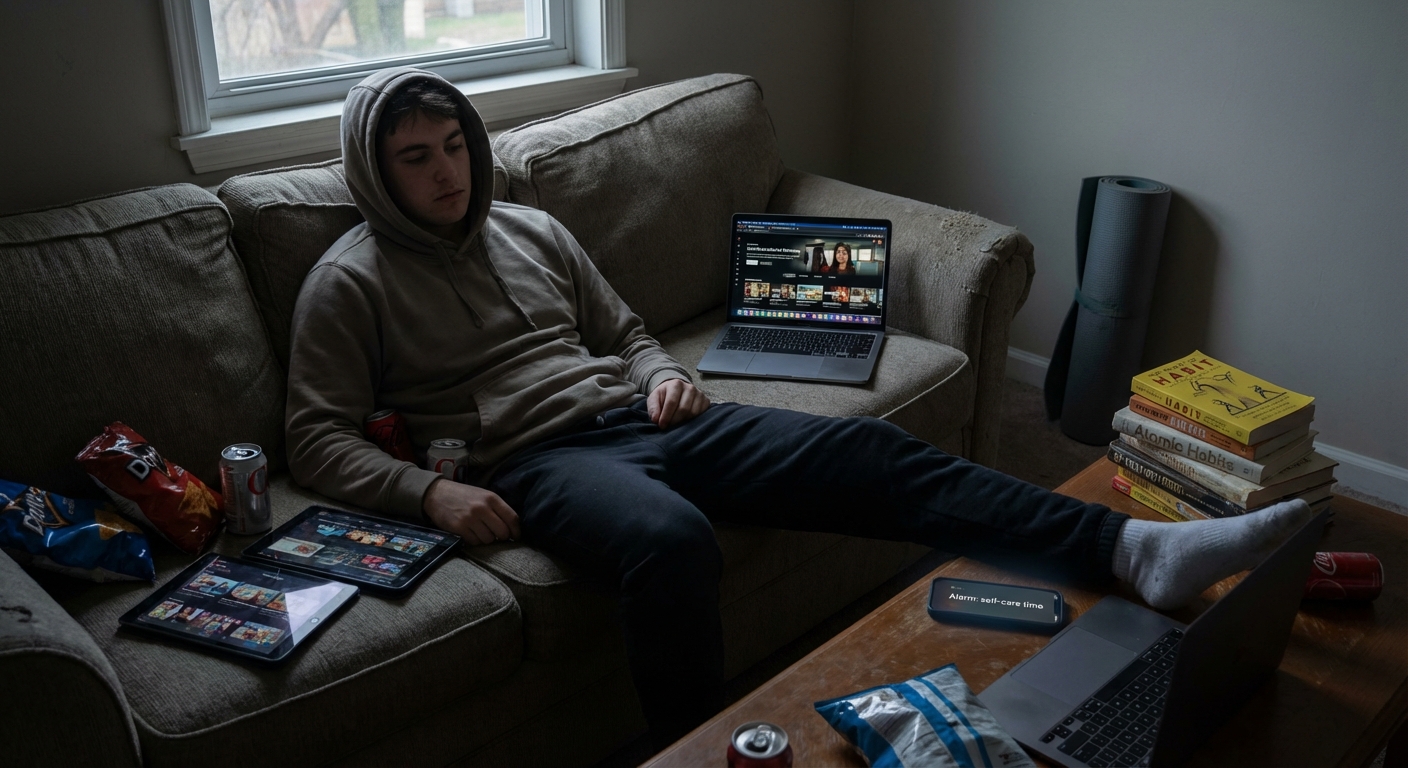
“Treat yourself” culture has a dark side.
Not Everything That Feels Good Is Good for You
A lot of habits we label as self‑care are actually self‑sabotage in comfy clothes.
They feel soothing in the moment… and quietly wreck your energy, focus, and confidence over time.
Psychotherapist Dr. Thema Bryant warns:
“Self‑care is not just about bubble baths and chocolate. It’s about creating a life you don’t need to regularly escape from.”
Let’s unpack seven “harmless” habits that might be stalling your self‑improvement — and what to do instead.
1. “I Deserve a Break” (That Never Ends)
Looks like self‑care:
- Binge‑watching “just one more” episode
- Scrolling for hours because “today was rough”
Why it’s sabotage:
You never actually recharge. You just numb out.
A study in the Journal of Communication found that people who binge‑watch often report higher fatigue and lower sleep quality — the opposite of rest.
Upgrade it:
- Keep entertainment, but time‑box it: e.g., 1–2 episodes, then stop.
- Try active rest: walking, stretching, reading, journaling, talking with a friend.
Micro‑swap:
Before you open Netflix or TikTok, set a timer for 30–45 minutes. When it goes off, stand up. Decide consciously if you still want more.
2. “I’m Just Being Realistic” (a.k.a. Automatic Self‑Doubt)
Looks like self‑care: Protecting yourself from disappointment.
- “People like me don’t get promoted.”
- “I’m not a morning person.”
- “I could never run a 5K / start a business / speak on stage.”
Why it’s sabotage:
Your brain starts believing your limiting stories as facts.
Stanford psychologist Dr. Carol Dweck’s research on growth mindset shows that simply believing you can improve changes your actual performance.
Upgrade it:
Instead of, “I can’t do that,” try:
- “I don’t know how to do that… yet.”
- “I’ve never done that before; what’s one tiny first step?”
Micro‑swap:
Catch one limiting statement today and add “…yet” to the end. Then write down one small experiment that would move you 1% closer.
3. “I Listen to My Body” (Except When It’s Addicted)
Looks like self‑care:
- Eating whatever you crave
- Sleeping whenever you feel tired
Why it’s sabotage:
Sometimes you’re not “listening to your body.” You’re listening to dopamine withdrawal.
Sugar, doomscrolling, and staying up too late all hijack your reward circuits.
Neuroscientist Dr. Jud Brewer explains:
“What feels like ‘comfort’ is often just the relief of feeding a habit loop.”
Upgrade it:
Distinguish between signal and urge:
- Signal: “I’m exhausted, my eyes are burning, I can’t focus.” (Real rest needed.)
- Urge: “I want to stay up and scroll even though I’m tired.” (Habit talking.)
Micro‑swap:
When you feel a strong urge, wait 90 seconds before acting. Most emotional and craving waves peak and fall in about a minute and a half.
If you still want it after 90 seconds, choose consciously.
4. “I Need to Process My Feelings” (Endless Loop Edition)
Looks like self‑care:
- Venting to friends
- Journaling about the same problem every day
- Rehashing old arguments in your head
Why it’s sabotage:
You cross the line from processing to ruminating — replaying pain without moving toward solutions.
A study in Clinical Psychology Review links chronic rumination to higher rates of depression and anxiety.
Upgrade it:
Use the Feel–Deal–Heal model:
- Feel – Name it: “I feel angry / hurt / scared.”
Deal – Ask: “What’s one thing I can do about this?”
3. Heal – Choose something soothing after you’ve taken or scheduled an action.
Micro‑swap:
End every vent session (with yourself or others) by answering: “Okay, what’s my next move?” Even a tiny action — sending an email, setting a boundary, planning a conversation — flips you from stuck to progressing.
5. “I Deserve This Purchase” (Retail Therapy Trap)
Looks like self‑care:
- Online shopping “to feel better”
- Constant small treats because “I worked hard”
Why it’s sabotage:
You get a quick dopamine hit, then:
- Financial stress creeps up
- Clutter builds
- The “good feeling” shrinks each time
A survey by Credit Karma found that 44% of Americans regretted at least one online impulse purchase in the last year.
Upgrade it:
Create a 24‑Hour Cooldown Rule:
- If it’s not a basic necessity, add it to a wishlist.
- Revisit in 24 hours. If you still genuinely want it and it fits your budget/values, go ahead.
Micro‑swap:
When you feel the urge to buy something to feel better, first spend 5 minutes doing something free that lifts your mood: music, stretching, sunlight, text a friend.
Then decide.
6. “I’m Protecting My Peace” (By Avoiding Everything Hard)
Looks like self‑care:
- Ghosting tough conversations
- Avoiding feedback
- Quitting every time things get challenging
Why it’s sabotage:
You’re not protecting peace. You’re protecting short‑term comfort at the cost of long‑term growth.
Psychologist Dr. Harriet Lerner writes:
“Avoidance is a false refuge. It buys you minutes of comfort and costs you years of your life.”
Upgrade it:
Differentiate between toxic and challenging:
- Toxic: demeaning, abusive, consistently disrespectful → absolutely protect yourself.
- Challenging: uncomfortable, stretching, requiring effort or vulnerability → usually where growth lives.
Micro‑swap:
This week, choose ONE uncomfortable but important thing you’ve been avoiding:
- Scheduling a medical appointment
- Asking for clarity at work
- Having a hard but honest talk
Set a 10‑minute timer and take just the first step (draft the message, look up the number, outline talking points).
7. “I’m Working on Myself” (Forever Preparing, Never Doing)
Looks like self‑care:
- Consuming endless self‑help content
- Organizing planners, systems, apps
- Waiting to “feel ready”
Why it’s sabotage:
You get the illusion of progress with none of the risk.
Reading is great. But at some point, it becomes spiritual procrastination.
Behavioral scientist Dan Ariely notes that we often overvalue planning because it feels productive, even when it doesn’t change outcomes.
Upgrade it:
Use the 1:1 Rule:
- For every 1 unit of self‑help content you consume, do 1 action based on it.
Read 10 pages? Apply one idea that same day.
Micro‑swap:
Before you open your next podcast, article, or book, write:
“I will apply this by…”
Then, after you’re done, take a 5‑minute action inspired by what you learned.
How to Tell Real Self‑Care from Self‑Sabotage (Fast Test)
Ask these three questions:
Does this still feel good tomorrow?
Is this helping Future Me or just Present Me?
If I repeated this daily for a year, where would I end up?
If you’re honest, your body usually knows the answer.
Shareable Insight: Comfort Isn’t the Goal. Capacity Is.
The point of self‑care isn’t to be comfortable 24/7.
It’s to increase your capacity:
- To handle stress without breaking
- To pursue goals without burning out
- To feel good about the life you’re actually living
So keep the candles and the cozy nights.
But pair them with boundaries, growth, honest conversations, and tiny brave actions.
That’s not self‑indulgence. That’s self‑respect.