
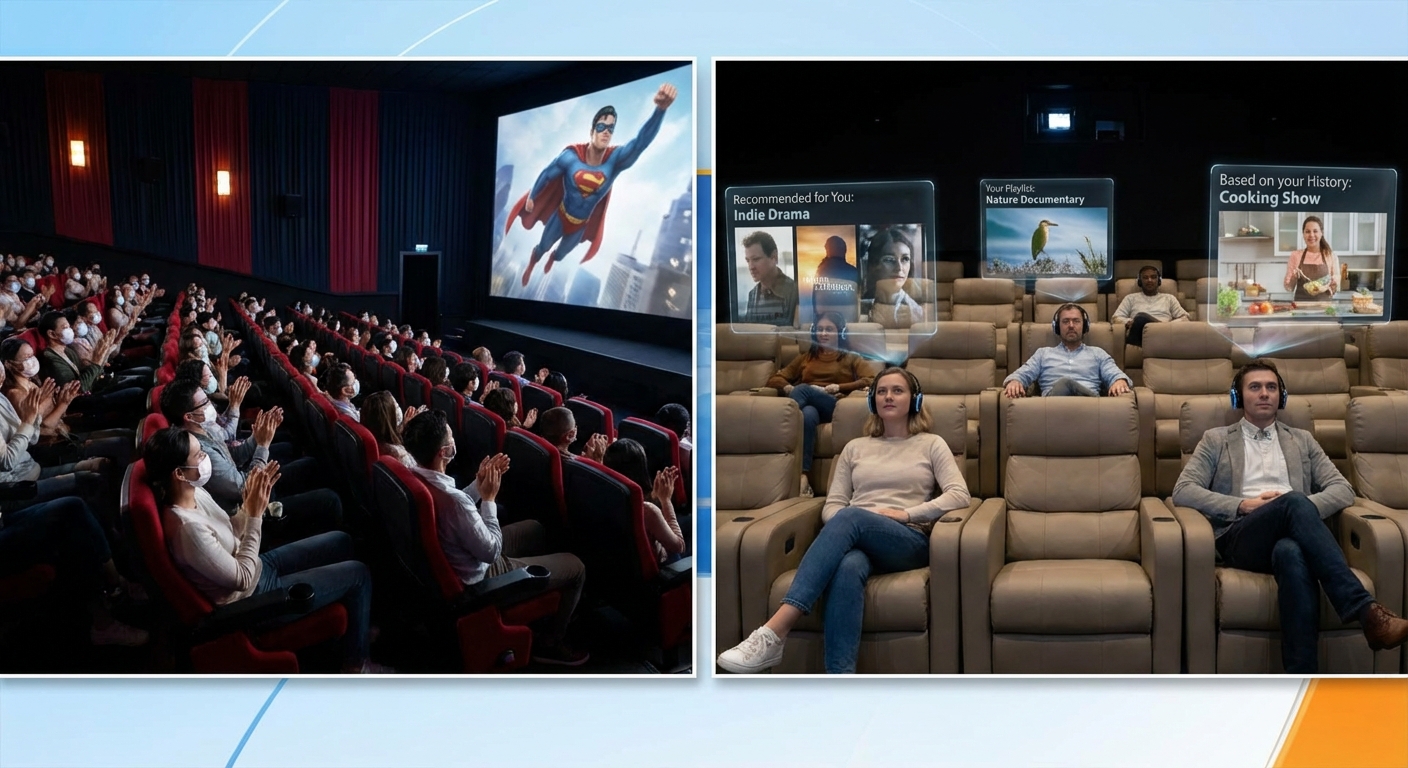
You didn’t plan to watch that random docuseries. Or that obscure Korean thriller. Or that hour-long video essay about a cartoon from 2004.
Your New Studio Boss Is an Algorithm
Yet here you are, three hours deep.
You didn’t choose it—the algorithm chose it for you.
Welcome to the quiet war between traditional studios and recommendation engines, where:
- Blockbusters chase your money.
- Algorithms chase your attention.
And increasingly, algorithms are winning.
The Old Play: Spend Big, Shout Loud
For decades, the formula was simple:
- Pour $100–$200 million into a major movie.
- Spend tens of millions on ads.
- Blast trailers on TV, billboards, magazines, and later—YouTube.
Studios relied on scarcity:
- Limited screens
- Limited new releases
- Limited ways to watch
“If you control distribution, you control demand,” explains film historian Dr. Marcus Hale. “That was the studio logic for 70 years.”
Then streaming services and social platforms quietly rewired the system.
The Algorithm’s Play: Know You Better Than You Know Yourself
Recommendation engines don’t care about:
- Prestige
- Red carpets
- Opening weekend bragging rights
They care about one thing: keeping your eyes on the platform.
They track:
- What you click
- What you hover on but don’t click
- What you abandon after 2 minutes
- What you watch to the end
- What you immediately rewatch
From this, they build a creepy-accurate profile:
“We joke that we know if you’re stress-watching, multitasking, or genuinely invested—just from your viewing patterns,” says an (anonymous) data scientist at a major streaming platform.
This is why:
- A small show with no marketing sometimes blows up.
- A heavily promoted blockbuster quietly sinks into the app’s basement.
The algorithm notices behavior, not billboards.
Surprising Fact: Micro-Hits Beat Mega-Hits Over Time
A big-budget movie might grab global attention for one weekend.
But a niche series that a small group obsessively rewatches and recommends?
That show:
- Hooks new subscribers
- Keeps old ones from churning
- Generates endless discourse
Economically, that can be worth more than a blockbuster.
“We’re in the era of the ‘long tail hit’—fast virality matters less than consistent, obsessed engagement,” says entertainment economist Lila Sandhu.
Algorithms are built to surface these micro-hits—the shows you’d never find in a theater lineup, but end up loving.
Studio Logic vs. Algorithm Logic (Side-by-Side)
| Question | Studio Era Answer | Algorithm Era Answer |
|---|---|---|
| What’s a hit? | Big box office / ratings | High watch time + retention |
| Who matters most? | Mass audience | Highly engaged niches |
| How do we promote? | Trailers, interviews, ads | A/B tested thumbnails, placements |
| How do we decide what to fund? | Exec taste + market research | Viewer behavior + data models |
They’re playing almost two different games.
Why Your Feeds Feel Biased (Because They Are)
Algorithms don’t just recommend—they steer.
They amplify content that:
- Is easy to click
- Hooks you instantly
- Sparks strong emotions (laughter, anger, awe)
Slower, more subtle stories can get buried.
“The danger is that we optimize for addiction, not art,” warns cultural critic Sofia Delgado. “What keeps you scrolling isn’t always what nourishes you.”
This explains why:
- Drama and outrage travel faster than nuance.
- Reality TV clips flood your feed even if you think you prefer documentaries.
Your declared taste and your behavioral taste aren’t always the same—and algorithms believe your actions, not your words.
How Creators Are Gaming the System (Legally)
Smart entertainers now design content for algorithms first, studios second.
Common tactics:
- Opening with the juiciest moment (no slow intros).
- Using bold, curiosity-poking titles and thumbnails.
- Creating series formats that encourage bingeing.
- Breaking big ideas into snackable chunks.
“The most successful creators think like showrunners and data analysts at the same time,” says digital showrunner Kenji Park.
These moves don’t just boost views—they signal to the algorithm: “People are hooked. Show this to more of them.”
Actionable: How to Beat the Algorithm at Its Own Game (As a Viewer)
You’re not powerless. You can hack your own feed.
1. Train It Like a Puppy
For one week:
- Click only on what you truly want more of.
- Immediately back out of stuff you don’t like (don’t let it play).
- Search manually for creators and genres you value.
You’ll see your recommendations shift shockingly fast.
2. Use “Watch Later” as a Shield
If you’re too tired for a smart doc now but want to watch it someday:
- Add it to your Watch Later / My List.
- Then go watch your comfort show.
You protect your attention and tell the platform, “More like this, please.”
3. Cross-Pollinate Your Taste
Find a creator you trust who:
- Recommends films outside the algorithm’s usual picks.
- Highlights international or indie projects.
Use their curation to break out of your algorithm bubble.
Actionable: How to Work With Algorithms (As a Creator)
If you’re making entertainment, you don’t have to sell your soul—but you do have to understand the rules.
Key levers:
- Hook fast: The first 3–5 seconds should create a question or surprise.
- Deliver steadily: Don’t stall—pay off what you teased.
- Ask for simple actions: “Save this for later,” “Comment your pick,” etc.
Remember: algorithms reward completed experiences.
- Short, fully-watched videos > long videos everyone abandons.
The Messy Middle: Can Art and Algorithms Coexist?
We’re in a strange hybrid era:
- Studios still chase blockbusters.
- Platforms chase watch time.
- Creators chase visibility.
Sometimes it aligns perfectly—a great movie or show is also wildly bingeable.
Sometimes it doesn’t, and brilliant work gets buried.
The hopeful view:
“Algorithms can surface voices studios never would’ve bet on—queer creators, international filmmakers, weird niche obsessions,” says producer Amira Soliman. “It’s chaotic, but more democratic.”
The cynical view:
“We risk a world where if it doesn’t trend, it doesn’t exist,” counters critic Jonah Reyes.
Both can be true.
Your Attention Is the Real Blockbuster Now
In the end, studios and algorithms are fighting over the same thing: you.
Your time, your clicks, your rewatches, your word-of-mouth.
The more intentional you are with where you spend that attention:
- The better your own entertainment experience gets.
- The more you reward the creators and stories you actually believe in.
You don’t control the studios.
You don’t control the algorithms.
But you absolutely control your next click.
That’s more power than Hollywood wanted you to know you had.